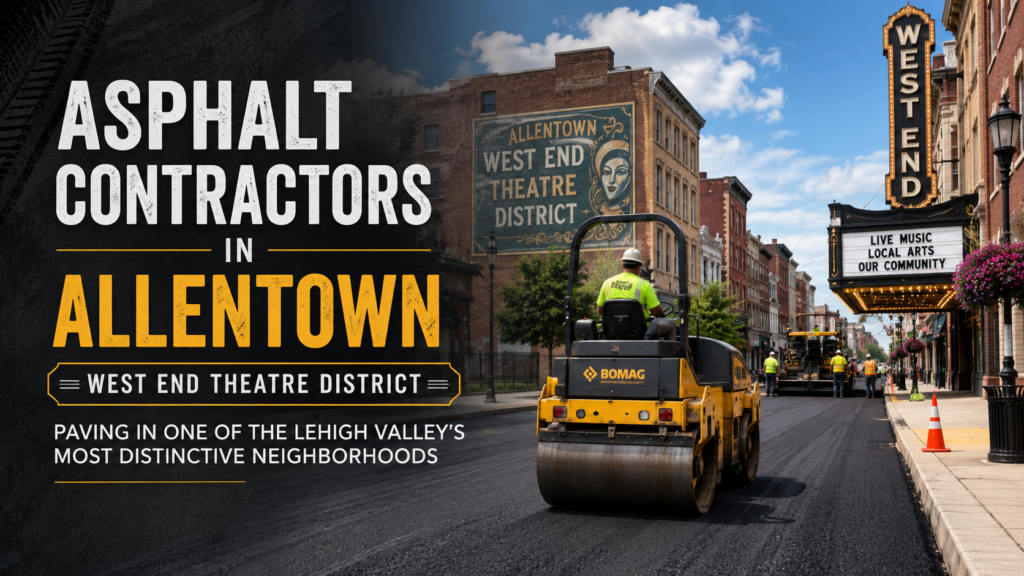
The West End Theatre District is the most vibrant mixed-use neighborhood in Allentown and one of the most distinctive commercial and residential communities in the Pennsylvania Lehigh Valley. Located between 17th and 22nd Streets east to west, and Liberty through Washington Streets south to north, the District is centered on 19th Street and anchored by the Civic Theatre of Allentown two venues, which have been staging theatrical productions in the neighborhood since 1957. Home to approximately 5,000 residents and 160 businesses, the District is distinguished by its Art Deco-era buildings, tree-lined streets, walkable scale, and a diverse mix of boutique shops, restaurants with international cuisine, local artisan businesses, and cultural venues. The neighborhood proximity to Muhlenberg College, Lehigh Valley Health Network 17th Street campus, the Allentown Fairgrounds, and the Allentown Farmers Market makes it a hub of daily activity that generates consistent and varied demand for Asphalt Contractor West End Theatre District services.
The Built Character of the West End Theatre District and Its Paving Context
The West End Theatre District urban fabric was established primarily between 1910 and 1940, when the neighborhood developed as Allentown westward residential expansion met the needs of a thriving industrial-era city. The district is marked by Arts and Crafts style townhomes and rowhouses from this era, alongside early twentieth-century Colonial Revival structures and mid-century commercial buildings along 19th Street. Most residential real estate in the District was built no later than 1939 a characteristic that makes the neighborhood historically rich but also means that driveways, parking areas, and private access surfaces associated with these properties are frequently well past their original design service life.
The dense, pedestrian-scaled character of the West End Theatre District also means that asphalt work here must be executed in tight urban conditions narrow streets flanked by parked vehicles and pedestrian activity, driveways that serve attached rowhouses with minimal side clearance, and rear alley parking areas that are accessible only through narrow passages between structures. Asphalt contractors experienced in dense urban residential environments bring both the equipment scale and the operational awareness that work in the Theatre District demands.
Residential Paving in the West End Theatre District
The dominant residential housing type in the West End Theatre District is the attached rowhouse or townhome. These structures, built between 1910 and 1940 on compact lots, typically have short front driveways or rear alley access rather than the long suburban driveways found in Allentown West End neighborhoods west of Cedar Crest Boulevard. Residential paving in this context focuses on:
- Short front driveway installation and replacement: Many Theatre District rowhouses have front driveways of 20 to 40 feet that connect the sidewalk to a garage at or near the house. These driveways are relatively small in area but technically demanding to install because of confined site conditions, the critical transition with the public sidewalk and curb, and the need to precisely match garage threshold elevations.
- Rear alley parking areas: The alleys that run behind many Theatre District blocks serve both utility access and parking for residents. Alley surfaces in this neighborhood range from asphalt in varying states of repair to brick-paved surfaces that reflect the original construction era. Asphalt contractors working in Theatre District alleys must manage narrow access, overhead obstructions, and coordination with neighboring properties that share the alley access.
- Patch and pothole repair: Existing driveways throughout the Theatre District that are structurally sound but have localized damage benefit from targeted repair that extends overall driveway life without the disruption of full replacement.
Commercial Paving Along 19th Street and the Theatre District Corridor
The commercial spine of the West End Theatre District 19th Street and the surrounding commercial blocks generates its own paving and maintenance needs distinct from the residential fabric. The approximately 160 businesses in the District include restaurants, retail boutiques, professional services, healthcare facilities associated with the nearby Lehigh Valley Health Network campus, and the Civic Theatre venues themselves. Commercial property paving needs in this context include:
- Small commercial parking lots: Many 19th Street businesses have small parking areas 10 to 30 spaces associated with their commercial use. These lots require the same systematic maintenance as larger commercial facilities: annual condition assessment, crack sealing, periodic sealcoating, and restriping. ADA compliance is required for any commercial parking facility, including the number of accessible spaces, their dimensions, slopes, and signage.
- Loading and service area maintenance: Restaurant and retail businesses along the commercial corridor have service and delivery areas that experience heavier-than-typical vehicle loads from delivery trucks. These areas may require more frequent attention and potentially heavier-duty asphalt specifications than standard light-vehicle parking areas.
- Sidewalk and curb coordination: In the Theatre District pedestrian-oriented commercial environment, where foot traffic along the 19th Street corridor is central to the neighborhood character, any paving or maintenance work that affects the sidewalk zone must be coordinated to maintain safe pedestrian access and to meet City of Allentown Right-of-Way permit requirements for work affecting the public sidewalk or curb.
Allentown Fairgrounds Area Traffic and Its Pavement Implications
One of the distinctive features of the West End Theatre District paving environment is the annual Great Allentown Fair, one of the longest-running county fairs in the United States, held annually the week before Labor Day at the Allentown Fairgrounds at 17th and Chew Streets. During the Fair, the Theatre District and surrounding streets experience dramatically increased vehicle and pedestrian traffic as hundreds of thousands of visitors converge on the fairgrounds. Commercial parking areas throughout the Theatre District that are used for event parking during the Fair experience concentrated loading during this period.
For property owners who use their commercial parking areas as event parking during the Fair, maintaining the surface in good condition is both a liability management necessity and a visitor-experience consideration. Sealcoating and striping performed in the months before the Fair presents the facility at its best during peak traffic.
The Freeze-Thaw Challenge in the Theatre District
Like all of Allentown, the West End Theatre District experiences Pennsylvania full four-season climate with meaningful winter freezing. For the neighbourhood pre-World War II building stock, this means that driveways and parking areas associated with these older properties have frequently endured many decades of freeze-thaw cycling without the benefit of systematic sealcoating and crack maintenance. The cumulative effect is visible throughout the District in the cracked, oxidized, and uneven driveway surfaces that characterize aging residential infrastructure in many older Allentown neighborhoods.
The practical guidance for Theatre District property owners is consistent across the industry: address existing cracks before winter with flexible rubberized sealant, apply sealcoating to oxidized surfaces that have not been treated recently, and plan for overlay resurfacing or replacement on surfaces where alligator cracking patterns indicate base-level structural deterioration. Proactive maintenance is far less disruptive and expensive than deferred replacement.
Pedestrian Safety and Work Zone Management in the Theatre District
The West End Theatre District active pedestrian environment requires particular attention to work zone management during any asphalt installation or maintenance project. The neighbourhood 19th Street commercial corridor is designed for walkability, and the residential streets see consistent foot traffic from residents, students from nearby Muhlenberg College, and visitors to the Civic Theatre and neighbourhood businesses. Any paving project that closes sidewalks or affects pedestrian access must include appropriate work zone safety measures: pedestrian detour signage, temporary protective barriers, non-slip surfaces across work zone transitions, and clear communication about access modifications.
City of Allentown Right-of-Way permits are required for any work that affects the public sidewalk, curb, or street within the Theatre District. Experienced asphalt contractors working in the Lehigh Valley are familiar with Allentown permit requirements and coordinate permit applications as part of their standard commercial project process.
Conclusion
Asphalt contractors serving the West End Theatre District operate in one of Allentown most distinctive and historically significant neighborhoods a dense, walkable, architecturally rich community where the practical demands of maintaining aging urban residential and commercial pavement infrastructure meet the aesthetic and pedestrian-safety expectations of a thriving mixed-use district. Property owners and commercial operators in the Theatre District who invest in proactive asphalt maintenance, work with contractors experienced in urban residential environments, and coordinate their projects with the neighbourhood pedestrian-first character protect both their property infrastructure and their contribution to one of the Lehigh Valley most vibrant neighbourhood communities.
The West End Theatre District is the most vibrant mixed-use neighborhood in Allentown and one of the most distinctive commercial and residential communities in the Pennsylvania Lehigh Valley. Located between 17th and 22nd Streets east to west, and Liberty through Washington Streets south to north, the District is centered on 19th Street and anchored by the Civic Theatre of Allentown two venues, which have been staging theatrical productions in the neighborhood since 1957. Home to approximately 5,000 residents and 160 businesses, the District is distinguished by its Art Deco-era buildings, tree-lined streets, walkable scale, and a diverse mix of boutique shops, restaurants with international cuisine, local artisan businesses, and cultural venues. The neighborhood proximity to Muhlenberg College, Lehigh Valley Health Network 17th Street campus, the Allentown Fairgrounds, and the Allentown Farmers Market makes it a hub of daily activity that generates consistent and varied demand for asphalt contractor services.
The Built Character of the West End Theatre District and Its Paving Context
The West End Theatre District urban fabric was established primarily between 1910 and 1940, when the neighborhood developed as Allentown westward residential expansion met the needs of a thriving industrial-era city. The district is marked by Arts and Crafts style townhomes and rowhouses from this era, alongside early twentieth-century Colonial Revival structures and mid-century commercial buildings along 19th Street. Most residential real estate in the District was built no later than 1939 a characteristic that makes the neighborhood historically rich but also means that driveways, parking areas, and private access surfaces associated with these properties are frequently well past their original design service life.
The dense, pedestrian-scaled character of the West End Theatre District also means that asphalt work here must be executed in tight urban conditions narrow streets flanked by parked vehicles and pedestrian activity, driveways that serve attached rowhouses with minimal side clearance, and rear alley parking areas that are accessible only through narrow passages between structures. Asphalt contractors experienced in dense urban residential environments bring both the equipment scale and the operational awareness that work in the Theatre District demands.
Residential Paving in the West End Theatre District
The dominant residential housing type in the West End Theatre District is the attached rowhouse or townhome. These structures, built between 1910 and 1940 on compact lots, typically have short front driveways or rear alley access rather than the long suburban driveways found in Allentown West End neighborhoods west of Cedar Crest Boulevard. Residential paving in this context focuses on:
- Short front driveway installation and replacement: Many Theatre District rowhouses have front driveways of 20 to 40 feet that connect the sidewalk to a garage at or near the house. These driveways are relatively small in area but technically demanding to install because of confined site conditions, the critical transition with the public sidewalk and curb, and the need to precisely match garage threshold elevations.
- Rear alley parking areas: The alleys that run behind many Theatre District blocks serve both utility access and parking for residents. Alley surfaces in this neighborhood range from asphalt in varying states of repair to brick-paved surfaces that reflect the original construction era. Asphalt contractors working in Theatre District alleys must manage narrow access, overhead obstructions, and coordination with neighboring properties that share the alley access.
- Patch and pothole repair: Existing driveways throughout the Theatre District that are structurally sound but have localized damage benefit from targeted repair that extends overall driveway life without the disruption of full replacement.
Commercial Paving Along 19th Street and the Theatre District Corridor
The commercial spine of the West End Theatre District 19th Street and the surrounding commercial blocks generates its own paving and maintenance needs distinct from the residential fabric. The approximately 160 businesses in the District include restaurants, retail boutiques, professional services, healthcare facilities associated with the nearby Lehigh Valley Health Network campus, and the Civic Theatre venues themselves. Commercial property paving needs in this context include:
- Small commercial parking lots: Many 19th Street businesses have small parking areas 10 to 30 spaces associated with their commercial use. These lots require the same systematic maintenance as larger commercial facilities: annual condition assessment, crack sealing, periodic sealcoating, and restriping. ADA compliance is required for any commercial parking facility, including the number of accessible spaces, their dimensions, slopes, and signage.
- Loading and service area maintenance: Restaurant and retail businesses along the commercial corridor have service and delivery areas that experience heavier-than-typical vehicle loads from delivery trucks. These areas may require more frequent attention and potentially heavier-duty asphalt specifications than standard light-vehicle parking areas.
- Sidewalk and curb coordination: In the Theatre District pedestrian-oriented commercial environment, where foot traffic along the 19th Street corridor is central to the neighborhood character, any paving or maintenance work that affects the sidewalk zone must be coordinated to maintain safe pedestrian access and to meet City of Allentown Right-of-Way permit requirements for work affecting the public sidewalk or curb.
Allentown Fairgrounds Area Traffic and Its Pavement Implications
One of the distinctive features of the West End Theatre District paving environment is the annual Great Allentown Fair, one of the longest-running county fairs in the United States, held annually the week before Labor Day at the Allentown Fairgrounds at 17th and Chew Streets. During the Fair, the Theatre District and surrounding streets experience dramatically increased vehicle and pedestrian traffic as hundreds of thousands of visitors converge on the fairgrounds. Commercial parking areas throughout the Theatre District that are used for event parking during the Fair experience concentrated loading during this period.
For property owners who use their commercial parking areas as event parking during the Fair, maintaining the surface in good condition is both a liability management necessity and a visitor-experience consideration. Sealcoating and striping performed in the months before the Fair presents the facility at its best during peak traffic.
The Freeze-Thaw Challenge in the Theatre District
Like all of Allentown, the West End Theatre District experiences Pennsylvania full four-season climate with meaningful winter freezing. For the neighbourhood pre-World War II building stock, this means that driveways and parking areas associated with these older properties have frequently endured many decades of freeze-thaw cycling without the benefit of systematic sealcoating and crack maintenance. The cumulative effect is visible throughout the District in the cracked, oxidized, and uneven driveway surfaces that characterize aging residential infrastructure in many older Allentown neighborhoods.
The practical guidance for Theatre District property owners is consistent across the industry: address existing cracks before winter with flexible rubberized sealant, apply sealcoating to oxidized surfaces that have not been treated recently, and plan for overlay resurfacing or replacement on surfaces where alligator cracking patterns indicate base-level structural deterioration. Proactive maintenance is far less disruptive and expensive than deferred replacement.
Pedestrian Safety and Work Zone Management in the Theatre District
The West End Theatre District active pedestrian environment requires particular attention to work zone management during any asphalt installation or maintenance project. The neighbourhood 19th Street commercial corridor is designed for walkability, and the residential streets see consistent foot traffic from residents, students from nearby Muhlenberg College, and visitors to the Civic Theatre and neighbourhood businesses. Any paving project that closes sidewalks or affects pedestrian access must include appropriate work zone safety measures: pedestrian detour signage, temporary protective barriers, non-slip surfaces across work zone transitions, and clear communication about access modifications.
City of Allentown Right-of-Way permits are required for any work that affects the public sidewalk, curb, or street within the Theatre District. Experienced asphalt contractors working in the Lehigh Valley are familiar with Allentown permit requirements and coordinate permit applications as part of their standard commercial project process.
Conclusion
Asphalt contractors serving the West End Theatre District operate in one of Allentown most distinctive and historically significant neighborhoods a dense, walkable, architecturally rich community where the practical demands of maintaining aging urban residential and commercial pavement infrastructure meet the aesthetic and pedestrian-safety expectations of a thriving mixed-use district. Property owners and commercial operators in the Theatre District who invest in proactive asphalt maintenance, work with contractors experienced in urban residential environments, and coordinate their projects with the neighbourhood pedestrian-first character protect both their property infrastructure and their contribution to one of the Lehigh Valley most vibrant neighbourhood communities.